
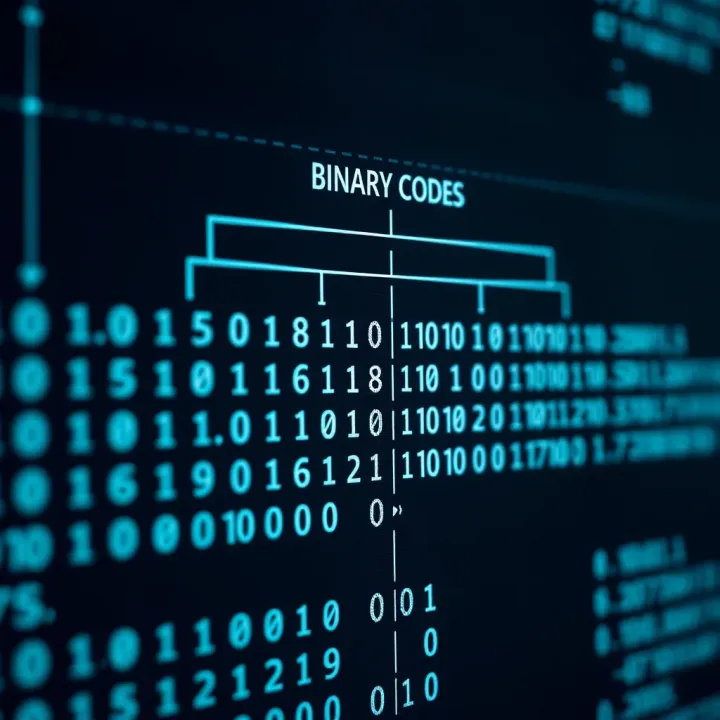
How ASCII Converts to Binary Explained
Learn how ASCII characters convert to binary with clear steps and practical examples 💻🔢. Perfect for coding beginners and tech enthusiasts in Pakistan!
Edited By
Elizabeth Carter
Binary to ASCII conversion plays a key role in how computers handle and display text. Since computers deal with data in binary form (strings of 0s and 1s), converting this code into readable characters is vital for communication and processing.
ASCII, or American Standard Code for Information Interchange, assigns a unique 7-bit binary number to characters like letters, numbers, and symbols. For example, the ASCII code for uppercase 'A' is 65, which in binary is 01000001.

Understanding this conversion helps traders and finance professionals interpret raw data streams, such as stock market feeds or encrypted messages, where numbers and symbols rarely appear as plain text initially.
Each character in ASCII corresponds to a 7-bit binary number.
Computers typically use 8 bits (one byte) per character, with the extra bit often set to zero.
A binary sequence like 01001000 01100101 01101100 01101100 01101111 translates to the word "Hello".
You can convert binary to ASCII by:
Splitting binary data into 8-bit chunks.
Converting each 8-bit chunk into its decimal equivalent.
Matching the decimal number with the ASCII character.
For example, the binary 01000001 converts to decimal 65, which represents 'A'.
Remember, precision matters here. Even one bit error changes the character entirely, which could lead to misinterpretation in data-sensitive fields like finance.
In Pakistan’s financial sector, tools that convert binary data into readable ASCII text assist in:
Decoding encrypted stock exchange messages.
Processing transaction logs from banks.
Understanding communication protocols in trading software.
Being aware of these basics allows finance professionals to troubleshoot technical glitches and verify data integrity.
In the next sections, we will explore automated methods and common pitfalls in binary-to-ASCII conversion to deepen your understanding for practical usage.
Understanding the basics of binary code and ASCII is essential when converting data from one form to another. This section lays the groundwork for grasping how computers handle text, starting with two key concepts: binary as the language of machines and ASCII as the system that links that language to readable text.
Binary code is the foundation of all computing systems. At its core, binary is a way of representing information using just two symbols: 0s and 1s. Each of these symbols is called a bit, short for "binary digit." This simplicity makes it extremely reliable for electronic circuits, which can easily distinguish between two states such as on/off or high/low voltage.
The binary numbering system works by counting in base 2, unlike the decimal system which counts in base 10. This means each position in a binary number represents a power of 2. For instance, the binary number 1011 equals 1×8 + 0×4 + 1×2 + 1×1 = 11 in decimal. Each bit holds more weight depending on its position, allowing us to represent large numbers or complex data using just combinations of 0s and 1s.
In computing, binary is crucial because every type of data—whether text, images, or videos—must be broken down into binary for processing and storage within a digital device. When you type on your keyboard or send a message through your mobile, the input transforms into binary so the device understands and handles it accordingly.
ASCII stands for American Standard Code for Information Interchange. It is a character encoding standard primarily for electronic communication. ASCII assigns unique numerical codes to 128 characters, covering English letters (both uppercase and lowercase), digits, punctuation marks, and some control characters like newline and tab.
Each ASCII character corresponds to a decimal number between 0 and 127. For example, the uppercase letter 'A' has the code 65, while the digit '5' maps to 53. When computers receive or send data, they use these numbers to represent characters, rather than the characters themselves. This numeric mapping makes it easier for computers to process and transmit text.
ASCII remains vital in text communication because it provides a common language recognized by almost all computer systems and devices. Despite newer encoding formats like Unicode supporting many languages, ASCII’s simplicity and backwards compatibility make it widely used, especially in programming, networking protocols, and legacy systems in Pakistan and worldwide.
Knowing how binary maps to ASCII codes helps you understand exactly how computers turn strings of 0s and 1s into readable text, a skill especially useful in software development, data analysis, and troubleshooting digital communication.

In summary, learning the fundamentals of binary and ASCII equips you to decode how digital messages are built and interpreted at the machine level, which is the first step towards mastering binary to ASCII conversion.
Converting binary code to ASCII is a fundamental skill for anyone dealing with digital data, especially in finance and trading sectors where raw data often comes in encoded forms. Understanding this process enables clearer interpretation and manipulation of machine-readable information, making data handling more efficient. For instance, traders managing algorithmic trading software might receive binary outputs that need accurate conversion into readable characters for analysis or debugging.
Binary data is organised in 8-bit groups called "bytes." Each byte corresponds to one ASCII character. Splitting a long binary string into 8-bit chunks is the very first step. For example, the binary string 0100100001100101 splits into 01001000 and 01100101. This separation is critical because ASCII encoding works in these fixed-size units. Without proper splitting, decoding will lead to incorrect or garbled characters.
After breaking the binary string into 8-bit sections, each chunk converts into a decimal number. This decimal acts as a key linking to an ASCII character. For instance, 01001000 in binary equals 72 in decimal. Calculating this involves multiplying each bit by 2 raised to its position's power and summing the results. Such a conversion is necessary because most ASCII tables index characters using decimal numbers.
Once the decimal number is known, identify its corresponding ASCII character from the ASCII table. For example, decimal 72 translates to uppercase ‘H’, and 101 corresponds to lowercase ‘e’. This step transforms raw binary data into readable text, which is essential in various financial software that present textual information coded in ASCII.
Several online platforms provide free binary-to-ASCII conversion tools. These are accessible through any browser without the need for installation. Examples include rapidtables.com and binaryhexconverter.com, which are widely used in Pakistan’s educational and professional environments for quick data decoding.
Automated tools save time and minimize errors compared to manual conversion. They handle large volumes of binary data efficiently, which is particularly useful for traders and finance professionals analysing extensive datasets or log files. Automation also supports varying binary lengths and non-standard inputs, which might trouble manual methods.
Offline software like Notepad++ with plugins or programming IDEs like Visual Studio Code offers reliable binary-to-ASCII conversion features. Such applications are valuable where internet access is limited or when working with sensitive financial data that requires privacy. These tools also allow batch processing and integration into larger codebases.
Mastering both manual and automated binary to ASCII conversion is a practical skill that improves data interpretation and communication in Pakistan's fast-evolving digital economy.
Understanding the common challenges in converting binary to ASCII helps avoid errors and makes the process smoother, especially for traders and professionals who deal with data encoding frequently. These challenges often involve formatting issues and the correct interpretation of character sets, which can affect data accuracy and usability.
Handling incomplete or incorrect binary strings is a common stumbling block. If a binary string is incomplete or contains errors, converting it directly to ASCII leads to wrong or unreadable characters. For instance, a string like 101010 missing the necessary bits for a full character (usually 8 bits) will create confusion in conversion tools. Ensuring the binary input is complete and error-free before conversion is essential to avoid misinterpretation, especially in financial software or communication systems.
The importance of 8-bit grouping cannot be overstated. ASCII characters are encoded in bytes, each consisting of 8 bits. When binary strings are not divided properly into these groups, the resulting ASCII text will be jumbled. For example, a binary number without correct segmentation may translate into unrelated symbols or gibberish. Proper 8-bit grouping maintains the integrity of the data and ensures each binary segment maps correctly to its ASCII counterpart.
Dealing with leading zeros is another practical aspect. Leading zeros in an 8-bit binary do not change the value but are crucial for maintaining the correct bit-length. For example, the letter 'A' in ASCII is decimal 65, which is 01000001 in binary, not simply 1000001. Skipping these zeros can cause software to misread the character, producing incorrect output. Traders must pay attention to maintaining leading zeros in reports or data files that use binary encoding.
Understanding the differences between standard and extended ASCII is vital when working with diverse data sets. Standard ASCII uses 7 bits to represent 128 characters, covering basic Latin letters, digits, and some control codes. Extended ASCII expands this to 8 bits, allowing 256 characters, including special symbols and characters used in various languages, which standard ASCII lacks.
The impact on conversion results can be significant when extended ASCII is involved. If a binary sequence represents an extended ASCII character but the conversion tool only supports standard ASCII, the output could be wrong or show strange characters. This problem often arises in cross-border communications and software localisation, where characters beyond the standard set are common.
Knowing when extended sets are needed is critical for accurate text representation. If your data includes special characters, such as currency symbols like the Pakistani Rupee sign (₨) or accented letters from Urdu transliteration, relying solely on standard ASCII won't work. Extended ASCII or Unicode becomes necessary for such cases, preserving meaning and preventing data corruption in financial documents or communication systems.
Accurate binary to ASCII conversion depends not just on the binary code itself, but on careful formatting and the correct character set interpretation. Overlooking these aspects can result in costly errors in data-driven environments.
By understanding and addressing these common challenges, traders and finance professionals can greatly improve the reliability of their binary-to-ASCII conversions, enabling better data processing and communication in their daily work.
Binary to ASCII conversion plays an essential role beyond theoretical knowledge, especially in modern computing and communication systems. Understanding how computers interpret text data in binary form helps traders, investors, and finance professionals appreciate the underlying technology that makes digital communication and software applications possible.
Binary codes in software development act as the fundamental building blocks for all computer operations. When programmers write code, every instruction and piece of text eventually translates into binary sequences the computer can process. For instance, source code written in languages like Python or Java is compiled or interpreted into binary that the machine understands, and ASCII provides a standard mapping for character representation.
Data encoding and decoding is vital when transferring or storing information involving text. Companies processing large volumes of data, such as financial transactions, depend on precise encoding standards to avoid errors. Binary to ASCII conversion enables systems to convert raw binary data into readable text formats, making reports, logs, and messages accessible across platforms. Without standardised conversion, data integrity could be compromised, affecting financial record accuracy.
Debugging with binary data is a common practice when diagnosing software faults. Developers often inspect binary sequences or memory dumps to track down glitches. Being able to convert suspicious binary codes into ASCII can help identify corrupted messages, wrongly encoded strings, or unexpected characters. For finance-related software, where even small errors can cause serious losses, this skill is practically invaluable.
Binary transmission in networks forms the backbone of all digital communication. Whether it’s sending banking transaction data through network hubs or streaming market prices on trading platforms, the information travels in binary. Converting this binary data to ASCII at endpoints ensures that text messages, alerts, or commands appear correctly. Reliable binary to ASCII conversion prevents miscommunication in sensitive financial processes.
Text representation in digital devices relies on ASCII to display readable content on screens or store it efficiently. For instance, ledger entry apps on mobile devices in Pakistan display transaction details using ASCII characters derived from binary data. This standardisation helps maintain consistency across diverse devices and software versions common in the local market.
Importance in encryption and security also ties back to how data is encoded and decoded. While encryption algorithms operate on binary data, ASCII plays a role in formatting encrypted messages or keys for human readability. Financial institutions use layered approaches where data stored or shared is first converted into binary, encrypted, and later converted back into ASCII upon decryption. This process ensures both security and usability.
Accurate binary to ASCII conversion underpins many digital systems financial professionals rely on daily. Understanding these practical applications can help you better grasp how technology supports secure, efficient financial operations.
This knowledge is especially useful in Pakistan’s growing digital economy, where software solutions and communication systems must work smoothly across various languages, platforms, and network conditions. Appreciating the link between binary data and ASCII characters clarifies many behind-the-scenes functions powering modern business tools.
Ensuring accuracy when converting binary to ASCII is essential for students and professionals working in computing or data-related fields in Pakistan. Mistakes in binary data or unsuitable tools can lead to incorrect outputs, which might cause bigger issues in software development, data processing, or digital communications. This section highlights practical steps and resources that are useful within the local context.
Verifying binary data before conversion is the first critical step. Often, binary strings might be incomplete, malformed, or contain errors like missing bits or incorrect grouping, especially when typed manually or copied from unreliable sources. Checking that binary sequences are divided into 8-bit chunks and ensuring no extra or missing zeros exist helps avoid conversion errors. For example, if a final chunk only has five bits, the ASCII representation would be wrong or fail. Students working on assignments or professionals debugging code should always cross-check the input binary to maintain integrity.
Choosing suitable tools relevant to local context also matters a lot. While many global websites offer quick binary to ASCII conversion, internet connectivity or restricted access in some areas may hinder their use. Therefore, local software solutions or lightweight downloadable tools that work offline provide reliable alternatives. These tools may also include Urdu or regional language support, making the process more accessible. Professionals dealing with large datasets benefit from batch conversion options offered by these programs tailored for Pakistani users.
Learning through practical exercises reinforces the understanding of binary to ASCII conversion. Schools and universities in Pakistan encourage hands-on practice; coding platforms and workshops run by local tech communities focus on real-life examples—like converting data packets or debugging machine code. Practising manual conversions alongside tool usage builds confidence and helps students spot common mistakes. For instance, converting simple text strings into binary and back clarifies how computers handle textual data.
Local software solutions and online platforms include apps and websites developed by Pakistani firms or programmers, often aligning with the specific needs of regional users. Platforms might offer conversion tools integrated with Urdu keyboards or support multiple character encodings used in Pakistan’s digital landscape. These tools help with everyday tasks, like analysing binary data from digital communications or troubleshooting network protocols.
Educational materials and tutorials are readily available in local universities and online through Pakistani educational channels. Tutorials often explain ASCII and binary conversion with examples relevant to Pakistan's syllabus or software industry. These resources help learners understand the theory and application, especially when preparing for tests like CSS computer science sections or technical interviews.
Community forums and support groups provide ongoing help for users at all skill levels. Whether on social media groups, programming forums, or local meetups, you’ll find students and professionals exchanging tips about binary conversion challenges and solutions. These groups foster collaborative learning and can be particularly helpful when facing unusual binary encoding issues or clarifying doubts about ASCII standards used in Pakistan’s IT sector.
Community forums and support groups create spaces for peer learning and troubleshooting. Members often share scripts, conversion tips, and advice on reliable tools. For instance, groups on Facebook or WhatsApp might offer instant help during late-night coding sessions, which makes them valuable for continuous learning and professional development.
Together, these practices and resources build a strong foundation for accurate binary to ASCII conversion tailored to Pakistan's educational and professional environment.
Learn how ASCII characters convert to binary with clear steps and practical examples 💻🔢. Perfect for coding beginners and tech enthusiasts in Pakistan!
Explore how binary division works in computing and digital electronics 📊. Learn practical methods and clear examples to master this key operation in simple steps.
Explore how binary search boosts efficiency in sorted C++ arrays 🚀, learn coding steps, common pitfalls, recursive & iterative methods, plus real-world uses.

📚 Learn how the binary search algorithm works, its key principles, practical uses, efficiency compared to other methods, and step-by-step coding tips. 💻
Based on 14 reviews